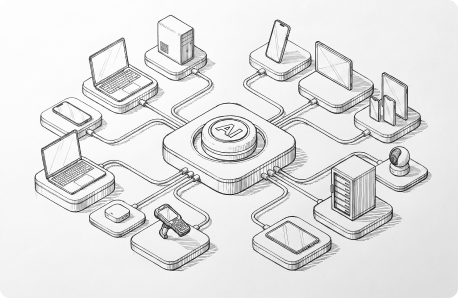
There is a persistent myth in the small and mid-sized business world: that mobile device management (MDM) is enterprise overhead — something you worry about once you cross a thousand employees. In reality, the opposite is true. SMBs are now among the most targeted and least protected organizations in the threat landscape, and the mobile devices their teams rely on every day are often the softest entry point of all.
Small Business, Enterprise-Sized Risk
Attackers do not check your headcount before they strike. What they look for is exposure, and smaller organizations offer plenty of it: personal phones accessing company email, laptops that never see a patch cycle, shared devices with no screen lock, and former employees whose access was never revoked. A single lost phone with an open mailbox can expose customer data, banking portals, and cloud logins in one move.
- Small businesses are targeted in a large share of all cyberattacks, yet only a fraction have any mobile security policy in place.
- The majority of breaches begin with a compromised endpoint — a phone, tablet or laptop.
- Data-protection and client-confidentiality obligations apply regardless of company size.
What MDM Actually Solves for a Small Team
MDM is not about surveillance or dictating how people work. For an SMB it delivers three practical guarantees:
- Visibility — one screen showing every device touching company data, its operating system, and whether it is compliant.
- Control — enforce a passcode, encryption and screen lock, push security updates, and remotely wipe a lost or stolen device before it becomes a breach.
- Separation — keep corporate apps and data in a managed container, so personal photos stay personal and company data stays protected, even on a staff member's own phone.
The BYOD Reality
Most SMBs run on bring-your-own-device by default, not by design. People use their own phones because it is convenient and inexpensive. MDM makes that arrangement safe: IT manages only the work profile, employees keep their privacy, and the business is no longer one lost handset away from a disclosure incident.
Why "Later" Is the Expensive Option
The cost of managing a small fleet is trivial next to the cost of a single incident — the downtime, the lost client trust, the potential regulatory penalty. Deploying management early, while the fleet is small, is also far easier than retrofitting policy onto a hundred unmanaged devices after something has already gone wrong.
Right-Sized, Not Scaled-Down
Modern platforms like UNO UEM are built so a five-person company gets the same enforcement engine as a five-thousand-seat enterprise, without the complexity. Enrolment takes minutes, policies ship from a single console, and an AI assistant handles the heavy lifting of interpreting posture and flagging what needs attention. For an SMB, that means enterprise-grade security without an enterprise-grade security team.
MDM is not something small businesses will need eventually. It is the baseline for operating safely today.